
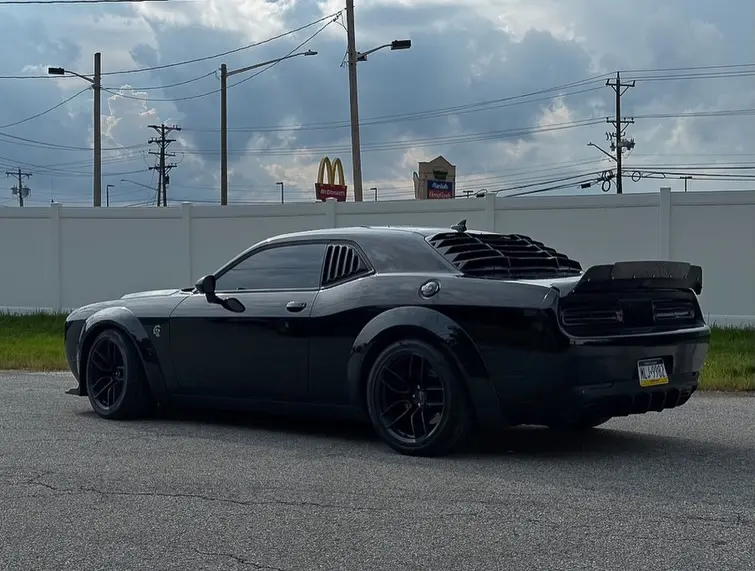
A customer brought us a “carbon fiber” spoiler for a Challenger last year. It weighed as much as a steel one, and when we flipped it over the weave stopped at the edge like wallpaper. It was ABS plastic with a printed film. He’d paid real carbon money for it.
This happens a lot, so here’s what we look for.
Here’s what you’ll find below:
- What’s the difference?
- Side by side
- How to spot fake carbon fiber in 6 checks
- When carbon-look is the smarter buy
What’s the difference between real carbon fiber and carbon-look?
Real carbon fiber is woven carbon cloth soaked in resin and cured into a rigid part. It’s very light and very stiff, and the weave you see is the structure, so it goes all the way through the part.
Carbon-look covers several things: ABS or fiberglass parts with a carbon-pattern film or hydro-dip on top, “carbon” vinyl wrap over a plain part, and fiberglass parts with one thin cosmetic layer of carbon cloth on the surface. The last one is sometimes sold as “carbon fiber” because technically there’s carbon in it.
Real vs carbon-look side by side
| Real carbon fiber | Carbon-look (ABS, film, wrap) | |
|---|---|---|
| Weight | Noticeably light for its size | Same as the plastic part underneath |
| Weave | Goes through the part; visible on edges and the back | Stops at edges; back is plain plastic |
| Pattern | Slight irregularities, cloth drape around curves | Perfectly repeating print, stretched or distorted on curves |
| Feel | Hard, rings when tapped | Dull thud, slight flex |
| Sun | Clear coat can yellow over years without UV protection | Film fades or peels; vinyl lifts at edges |
| Price | High | A fraction |
| Fit | Varies by maker; good ones fit well, cheap ones warp | Usually molded to the factory part, fits well |
How to spot fake carbon fiber in 6 checks
Here are the 6 checks we do on every “carbon” part that comes through the door:
- Look at the back
- Look at the edges
- Pick it up
- Follow the weave around a curve
- Tap it
- Read the listing carefully
Let’s go over each check.
1. Look at the back
Real carbon shows weave on the back too, usually rougher and unfinished. Carbon-look shows smooth black plastic or fiberglass. This one check catches most fakes.
2. Look at the edges
On a real part the weave runs through the cut edge like the layers in plywood. On a filmed part the pattern stops at the edge, and you can often see where the film was trimmed.
3. Pick it up
Carbon is startlingly light. If a mirror cap or spoiler weighs what you’d expect plastic to weigh, it’s plastic.
4. Follow the weave around a curve
Real cloth drapes around a curve, so the weave compresses or shifts slightly on tight bends. Printed film stretches, so the squares get bigger or distorted on the curve, and hydro-dipped parts often show a seam.
5. Tap it
Real carbon is stiff and has a sharp, almost metallic tap. ABS has a dull plastic thud and a little flex.
6. Read the listing carefully
Watch for “carbon fiber look,” “carbon fiber style,” “carbon pattern,” “carbon print” or “CF look.” Real parts usually say “real carbon fiber,” “dry carbon” or “pre-preg” and show photos of the back. A “carbon fiber” spoiler for $120 shipped is not carbon fiber.
Flip it over. If the back is smooth black plastic, it’s not carbon, no matter what the listing says.
When carbon-look is the smarter buy
Honestly, often. If you want the look on a daily driver and don’t care about weight, a well-molded ABS part with a quality film or a carbon vinyl wrap gets you most of the look for a fraction of the price, and it usually fits better than cheap real carbon. Real carbon is worth it when weight matters, when you want the depth and shine of a real weave up close, or when the part is somewhere you’ll touch and see every day, like mirror caps and interior trim.
What we won’t do is let you pay real carbon prices for a fake. Bring the part by, or send us the listing before you order, and we’ll tell you what it is.

Installing carbon fiber parts
Real carbon is stiff, which means it doesn’t forgive a bad fit the way plastic does. We test-fit every piece, shim or trim where needed, and mount with hardware that won’t crack the resin. Here’s how we install a front lip, and here’s everything we install in Wilmington.
Carbon fiber FAQ
How can I tell if carbon fiber is real?
Look at the back and the edges. Real carbon shows the weave on the back and through the cut edge. Carbon-look shows smooth plastic on the back and a pattern that stops at the edge. Real carbon is also much lighter.
Is carbon-look vinyl wrap a good option?
For the look on a budget, yes. Quality carbon-pattern cast vinyl on a roof, hood, mirrors or trim looks good and comes off clean. It won’t fool anyone up close, but it’s a fraction of the price.
Does real carbon fiber yellow?
The clear coat over it can, with years of sun and no UV protection. A good clear with UV inhibitors, a ceramic coating or garage parking slows it down a lot.
What is dry carbon vs wet carbon?
Dry (pre-preg) carbon is cured under heat and vacuum, so it’s lighter, stiffer and has a matte or satin look. Wet carbon is hand-laid with resin and usually has a thick glossy clear coat. Both are real carbon. Dry costs more.
Will you install carbon parts I bought?
Yes. We check them first and tell you what they are before anything goes on the car.